How to Choose & Buy the Right Travel Backpack
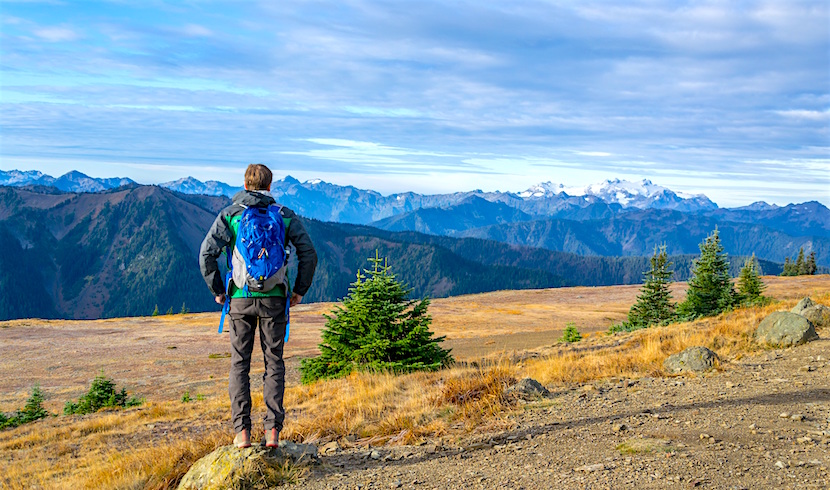
Picking the right travel backpack is an important part in planning your trip. Pick a bag that’s too big and you’ll have too much extra weight to carry around. Too small and you’ll never fit all your stuff in the thing! Pick the wrong material and your stuff will be soaked when it rains.
These days, there are so many backpacks out there that it can be confusing to know how to pick the right one. But there’s actually a science to knowing what the best travel backpack is — and how to pick it!
When I first started traveling, I spent weeks picking out my first travel backpack. I tried on dozens, did hours of online research, and tested them in the store to get a feel for what they would be like.
It was a time-consuming process. However, that research paid off though as my first backpack lasted me 8 years.
In fact, the only reason I bought a new backpack was because an airline lost that bag. Otherwise, that backpack would still be around today.
There are many travel backpacks in the world — and even more places where you can purchase one.
How do you pick the best backpack for traveling?
Today, I’m going to teach you how.
To save you hours upon hours of research, I’m going to lay out all the good qualities a backpack should have, the best backpack brands, and where you can buy them so you can save yourself hours of time and simply purchase one knowing it’s amazing and going to last forever.
Table of Contents
What to Look for in a Good Travel Backpack
Here’s a video of me dissecting my backpack and going over what I look for when picking the best backpacks for travel:
Don’t want to watch the video? No problem! Here’s a summary of it and how you can pick the best travel backpack for your trip:
The best backpacks — the ones that last the longest and stay in good condition no matter how much you abuse them — have all the following characteristics that make them durable, long-lasting, and weatherproof. Don’t get a backpack that doesn’t check off all the boxes on this list:
1. Water-Resistant Material
While your pack does not need to be 100% waterproof (unless you’re going on a long multi-day hike), make sure your bag is made out of a semi-waterproof material so everything doesn’t get wet in a drizzle (most travel backpacks come with covers you can put over them in case of a severe downpour).
Moreover, make sure the material won’t stay wet long and thereby get musty. I look for material that is thick but lightweight. Treated nylon fiber is really good. You should be able to pour a cup of water over it without the insides getting wet. I’m not traveling a lot during torrential downpours or monsoons, but I have been caught in small rainstorms before. Because my backpack is made out of good material, I’ve never opened my bag to find wet clothes.
2. Lockable Zippers
Make sure each compartment has two zippers so you can lock them together. While I am not really worried about people breaking into my bag and stealing my dirty clothes in a hostel, I like locking up my bag when I am traveling. I’m always paranoid that someone is going to put something in my bag or that a grabby baggage handler in an airport is going to take my stuff.
When purchasing locks, make sure the package says they are TSA-friendly locks. These locks have a special release valve that allows the TSA to open the lock without breaking it so they can check your bag. You can purchase TSA locks at any large retail store, such as Target or Walmart.
If you’re extra concerned about security (such as if you’re a photographer that carries a lot of expensive equipment), you should consider getting a Pacsafe bag). These bags are specifically designed with security in mind, and have a ton of features to ensure that your bag isn’t broken into or swiped.
3. Multiple Compartments
A good bag must have multiple compartments. This allows you to sort your belongings into smaller sections so it’s easier to find the stuff you need. For example, my clothes are in the main compartment of my bag, my umbrella and flip-flops in the top, and my shoes in a separate side compartment (that way they don’t get everything dirty). It saves having to dig around your bag. And while any bag you purchase should have multiple compartments, also pay attention to specialty compartments that might be important to you, such as a laptop sleeve or external water bottle pocket.
For added organization, purchase some packing cubes. They can keep your bag organized — even if you have multiple compartments.
4. Padded Hip belt
Most of the weight you will be carrying around will be pushing down on your hips, so you’ll want a padded belt to make supporting the weight more comfortable. The belt provides support and distributes the load more evenly on your back, causing less strain. The hip belt should also be adjustable so you can tighten it for extra support. Look for a bag that has zippered pockets in the hip belt too for easy access. These pockets are good for loose change, bus passes, and other small things you need quick access to.
5. Padded Shoulder Straps
These make carrying your load more comfortable, as the weight of your pack will also be pushing down on your shoulders. The pads will put less pressure on your shoulders and also help take pressure off your lower back. Make sure the padding is very thick and made up of a single piece of material as it will be less likely to split and thin out.
The best way to test this out is to visit a store and try the bag on. Have a staff member load the bag with things so you can see how it feels on your shoulders when fully weighted.
6. Contoured/Padded Back
A lumbar-shaped pack makes carrying it more comfortable, as it helps distributes weight more evenly (the same principle applies as is used in contoured chairs). It allows for a more natural arch to ensure no back pain. Moreover, this type of pack creates a small space between your back and the bag, allowing air to move through and help keep you slightly cool (lugging your bag around can work up a sweat!).
7. Front Loading
A front-loading backpack is one that allows you to zip open the face from the side and access all your stuff. A top-loading bag only allows you to access your stuff from a hole in the top. This makes getting your stuff (especially if it is at the bottom of your bag) really difficult. Always get a backpack that is “front loading” so you have easy access to all your gear.
Conversely, a bag with both top-loading and bottom-loading will suffice as well. Just make sure you don’t buy a bag with only one opening as that will make accessing your stuff inconvenient.
The Best Travel Backpacks: Does Size Matter?
One of my most frequently asked questions about backpacks is about size. Everyone wants to know what the perfect size is. No one backpack size is better than another. What matters is that your backpack should be proportional to your body — that might mean a backpack that is 40 liters or 60 liters.
If your backpack is too big or too small, the weight won’t be balanced properly and will cause back pain or maybe even make you topple over. You don’t want a skyscraper rising up from your back, but you also don’t want a pack that is clearly too small and overflowing with your stuff.
You want a backpack that is big enough to hold just a bit more than the stuff you are bringing and not more than that. Keep in mind that you don’t need to bring everything but the kitchen sink when packing for your trip. Besides the essentials like your passport, wallet, and phone, it’s not hard to find the things you need on the road. I like to carry enough clothes for 7-10 days, do laundry, then repeat. There’s no need to bring a lot of stuff when you can just wash what you have.
If a backpack fits everything you want, has a bit of extra room, and feels comfortable, then you have found the perfect backpack size. Manufacturers also have suggested torso and waist sizes for each model they produce, but I’ve found that the best way to know if a backpack feels right is to simply try it on.
When you are at the store (and any good camping/outdoors store will do this), they should be able to stuff your backpack with the equivalent of 30 pounds (15 kilograms) so you can see how that much weight feels on your back.
It’s important to remember that the bigger your backpack is, the less likely it is that you’ll be able to carry it on the airplane. Additionally, since you can’t bring liquids in containers larger than three ounces on airplanes if your bag has soap and liquids in it, you’ll be forced to check the bag. Most baggage sizes are 45 linear inches (22 x 14 x 9 in) or 115 centimeters (56 x 36 x 23 cm) including handles and wheels so if you get a backpack with those dimensions, you’ll be able to carry on. This is roughly 40-45L (depending on the brand and shape). If you want to fly carry-on only, aim for a 40-45L bag.
You generally won’t face any baggage fees from the major airlines for checking your bag when flying internationally. Budget airlines, on the other hand, charge a fee for checking a bag based on weight, so the more your bag weighs, the more you will have to pay to check it at the gate. Even though my bag fits in the overhead bin, I often have to check it when flying a budget airline.
The Eternal Question: Should you Buy a Backpack or Suitcase?
I have a confession: I hate suitcases for long trips. If you’re traveling around the world, your luggage is going to get thrown about and piled high on buses in random countries. It will get used and abused and it’s simply hard to walk up hills and stairs with your suitcase bumping everywhere. Try carrying a suitcase up five flights of stairs in a tiny hotel in Italy! It’s a pain!
Suitcases are great for weekends away or if you’ll be staying in one place for a long time. I always use a carry-on suitcase on my short trips.
But, if you are moving around a lot and backpacking around the world, it is far better to have a proper backpack. They are simply more versatile, easier to carry up flights of stairs, pack into tight places, and overall, they just make life simpler. I don’t need to pick them up when getting on the escalator or drag them up a flight of stairs or across cobblestone streets.
Backpacks just make more sense, which is why this page is devoted to them and not suitcases.
If you have back problems and can’t use a backpack, a smaller suitcase with wheels and a long handle can be a good substitute. It will still be difficult carrying it up and down stairs, and annoying as you roll it across uneven sidewalks, but there are many companies that make fairly good and lightweight travel cases.
Additionally, you can get a hard backpack with wheels that’s sort of a hybrid between the two so you can get the best of both worlds. (However, my personal preference is for a backpack so we’re going to talk about that!)
Travel Backpacks: How Much Should a Backpack Cost?
Backpack prices depend a lot on size, fabric, and brand. Most backpacks cost between $99–300 USD. The medium-sized store brands generally cost around $199 USD. Store brands are cheaper than big-name brands like North Face, Osprey, and Gregory.
I don’t believe that any backpack is worth more than $300 USD, no matter how nice it is. These expensive backpacks tend to be large and have more bells and whistles, special padding, and material than you really need as a traveler.
Additionally, don’t limit yourself to whether a backpack is labeled as a “hiking” or “camping” or “travel” backpack. Buying a backpack that was meant to be used in the Rockies instead of the streets of New Zealand doesn’t matter.
Hiking-specific backpacks usually are more rugged-looking and have outdoor-specific features (such as straps for attaching camping and other gear), while the new generation of “travel packs” are usually sleeker-looking and designed for the modern urban digital nomad with a focus on organization.
You should aim to spend between $100–250 USD on a backpack.
The Best Travel Backpacks: My 7 Favorite Packs
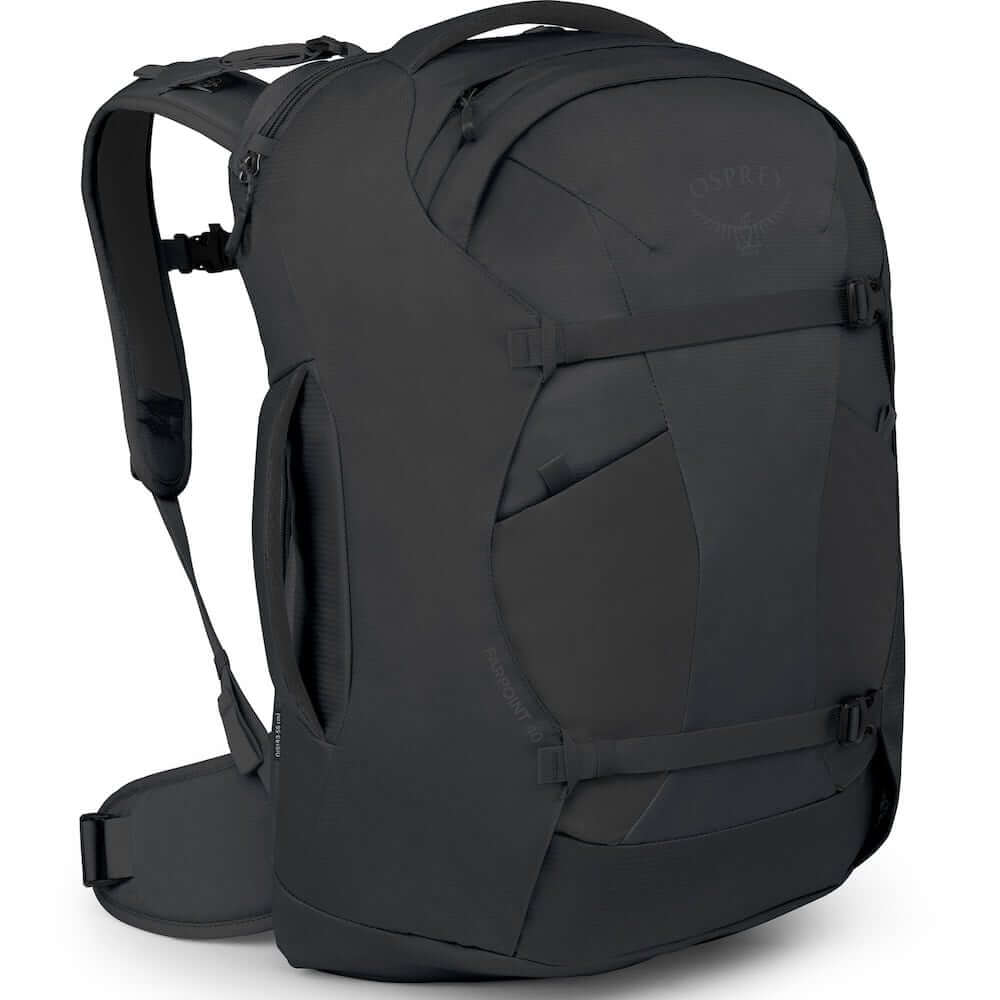
A flexible backpack for both short and long trips, perfect for carry-on only travelers who want to minimize their luggage. Especially ideal for travelers heading out on city breaks. Also works as a larger day bag.
Size: 40L
Straps: Dual front compression straps, two internal compression straps, padded top and side handles
Features: Lockable zippers, toiletry compartment, large front access to main compartment, breathable frame, laptop sleeve
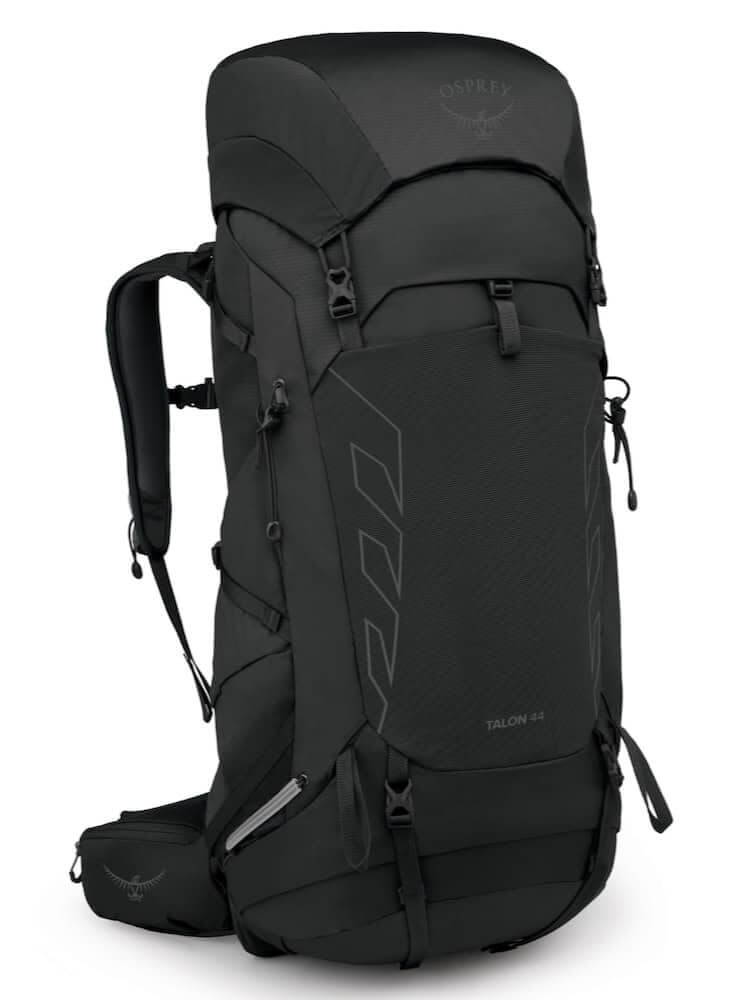
A great choice for travelers who plan to stay active and organized. It’s super comfy, has tons of pockets, and the top and bottom access ensures you can always find what you need. With a deep pocket for a water bottle as well as a hydration bladder, it’s a solid choice for both hikers and backpackers who plan to be on their feet a lot.
Size: 44L
Straps: Dual upper and lower side compression straps, adjustable padded shoulder and waist straps
Features: Hydration compatible, lots of pockets, top and bottom access for easy access/organization
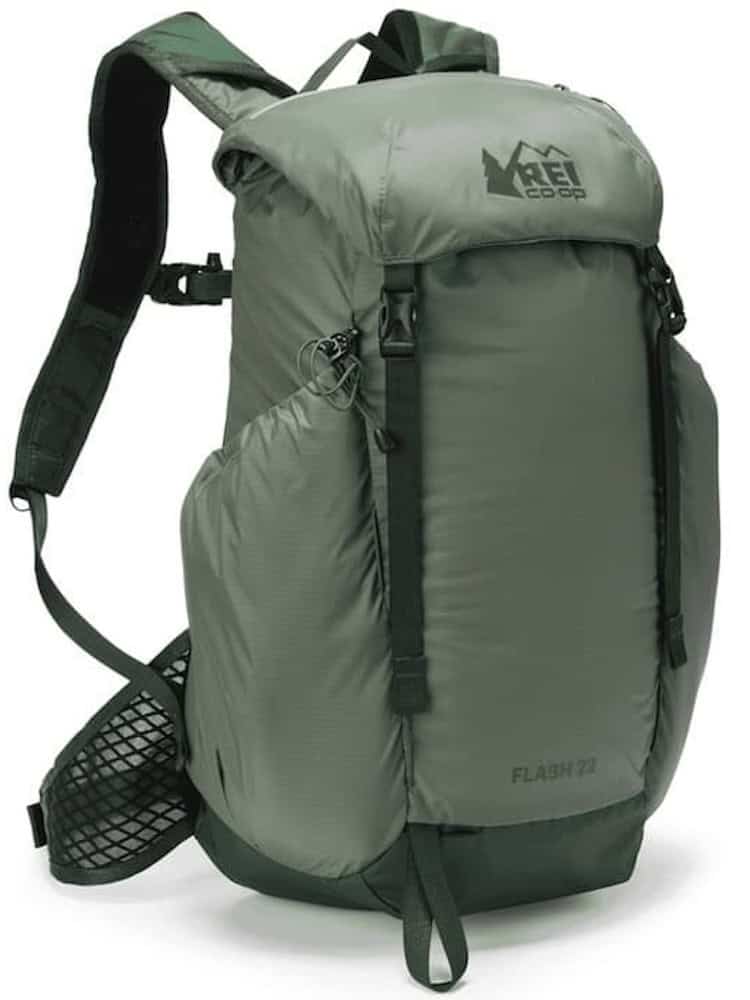
A small but versatile day bag that’s perfect for short hikes or day-long excursions around a city. It’s light, breathable, and even comes with a small pad that you can remove and use as a seat whenever you want to take a break. It’s the smaller version of my go-to backpack, the Flash 55.
Size: 22L
Straps: Breathable mesh shoulder straps, detachable sternum strap, sunglasses loop
Features: Hydration compatible, deep pockets for water bottle, zippered side pockets for easy access, exterior loops for extra storage, breathable back with removable seating pad
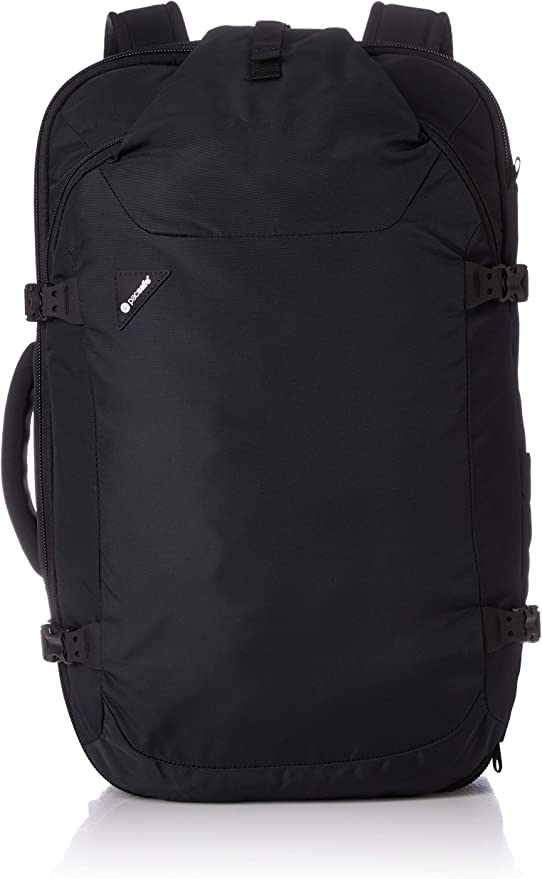
Pacsafe’s bags are all about their extra security features, like exomesh slash guard fabric to protect against “slash-and-run” thefts. It’s a good option if you carry expensive gear.
Size: 45L
Straps: Breathable shoulder and waist straps, sternum strap, external and internal compression straps
Features: Main compartment accessible through back panel, smart zipper security, 15-inch laptop sleeve, water bottle side pockets
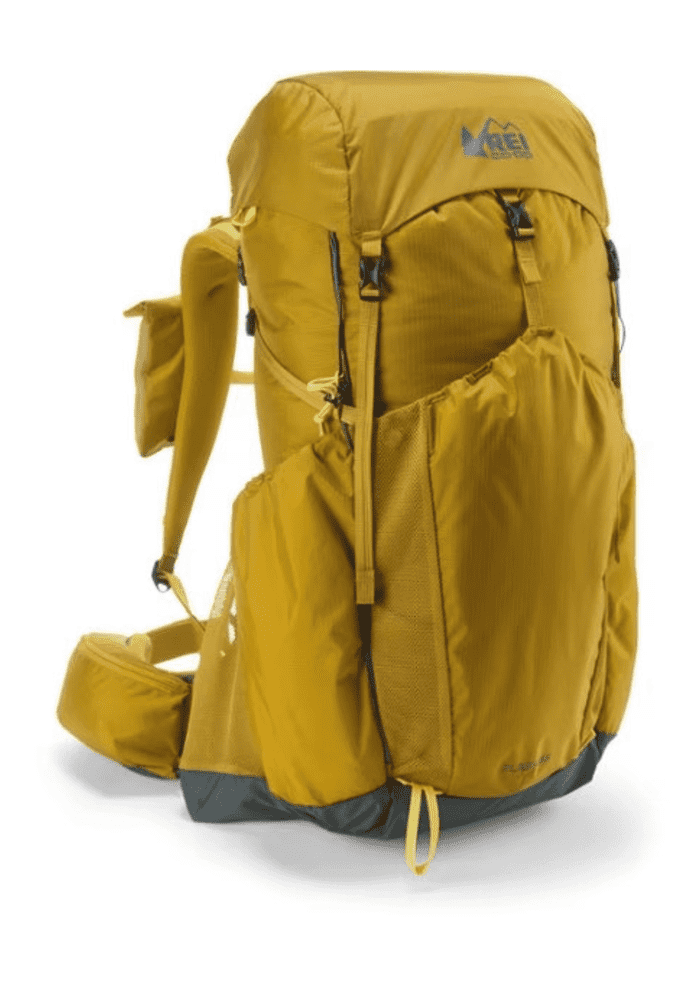
The back paneling on this pack is breathable, and the handy water bottle pocket is located near the front of the hip belt so you never have to take off your backpack to get a drink. The low weight of the bag itself plus the excellent hip support makes for comfortable usage, even for long distances. The design is great!
Size: 53-57L
Straps: Compression technology pulls the pack’s load up and inwards so that the pack is closer to your center of gravity
Features: Removable top lid, large pocket at the front, hydration compatible, 3D contoured hip belt
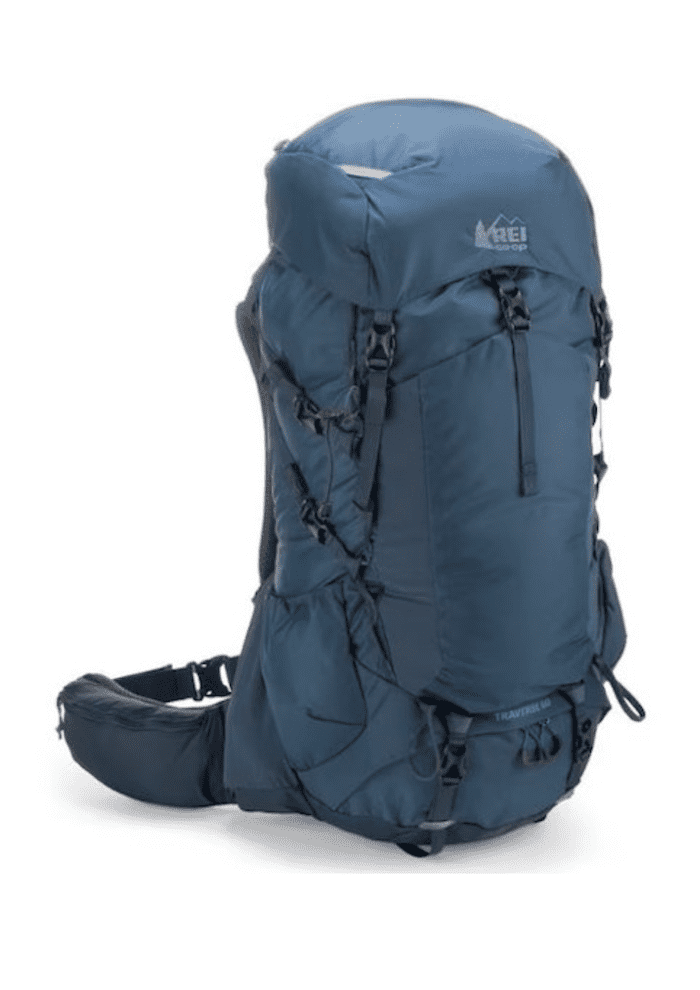
REI’s Traverse pack keeps the weight of your contents well balanced, and comes with a ventilated mesh back panel. The top lid turns into a small day pack or sling!
Size: 60L
Straps: Adjustable padded shoulder straps and hip belt
Features: Large zippered front pockets, accessible water bottle pockets, hip belt pocket, hydration compatible, rain cover
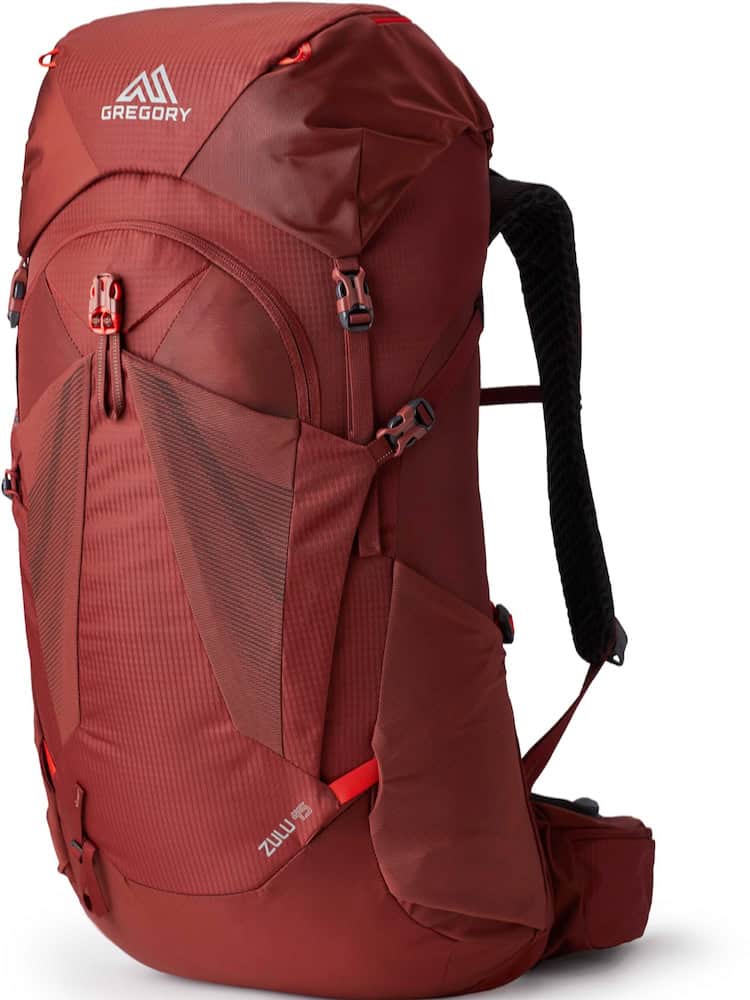
Similar to the Talon 44, this backpack works both for city trips and excursions out into nature. The straps are comfortable enough for hiking and the back panel is well ventilated. With deep pockets for a water bottle and room for a hydration bladder, it’s another solid choice for backpackers who plan to be on the go a lot.
Size: 45L
Straps: Padded shoulder and waist straps, sternum strap, external and internal compression straps
Features: Adjustable torso length, ventilated back panel, hydration compatible, large zippered hip belt pockets, dual mesh pockets plus a large mesh pocket on the front for extra storage
Where to Buy Your Travel Backpack
There are a lot of camping stores out there. Here are the best places to buy a backpack:
- REI – This is my favorite outdoor store. They have amazing service, knowledgable staff, cool events, and the best refund policy ever. This is a place that cares.
- EMS – Another great outdoor store with a wide selection of bags, great places, and friendly staff.
- MEC (Canada) – The REI of Canada is the best place to buy a backpack if you’re Canadian.
- GO Outdoors (UK)– The REI of the UK is the best place to buy a backpack if you’re a UK resident.
 I personally use an REI backpack. REI is an American company that sells a wide variety of sporting, outdoors, and travel gear. I’ve had my backpack since 2004 and it works, looks, and feels just as it did the day I bought it. You know those advertisements where they try to destroy products in order to prove how good they are? Well, my life is that ad. I have put this backpack through the ringer. It’s been crushed, thrown around, dropped, squeezed into tiny places, dragged, and kicked around.
The quality of their products has made me an REI customer for life. I buy all my travel gear there — from daypacks to bug spray to tents to sleeping bags. Additionally, I love REI’s one-year warranty and return policy. I know if something goes wrong, I can take the gear back — even after I’ve used it!
Buying a backpack for your trip is going to be a time-consuming process. You’ll need to try a lot on. If possible, head to your nearest outdoor store to try the bags on. You can get input and advice from the store’s staff, who will be able to answer any and all questions you have about your backpack. They can walk you through the proper fitting process too.
Conversely, you can also just get a bunch sent to your house, load them with all your gear, and try them on to see what one feels right. That way you will know exactly how the bag fits when you have your gear in it, not padding in the store. Return the others (so make sure to check the return policy before purchasing).
However, this process doesn’t need to be too painful if you follow the rules laid out in this post. If you do, you’ll find the perfect travel backpack for your trip in no time at all!
And it will be a backpack that will last you years and years and years!
READ NEXT —-> What to pack on your trip (For women travelers, click here.)
P.S. If you found this article helpful, consider using this link to purchase your bag (whatever brand you go with). The small commission helps me keep the website community supported free from sponsored content.